
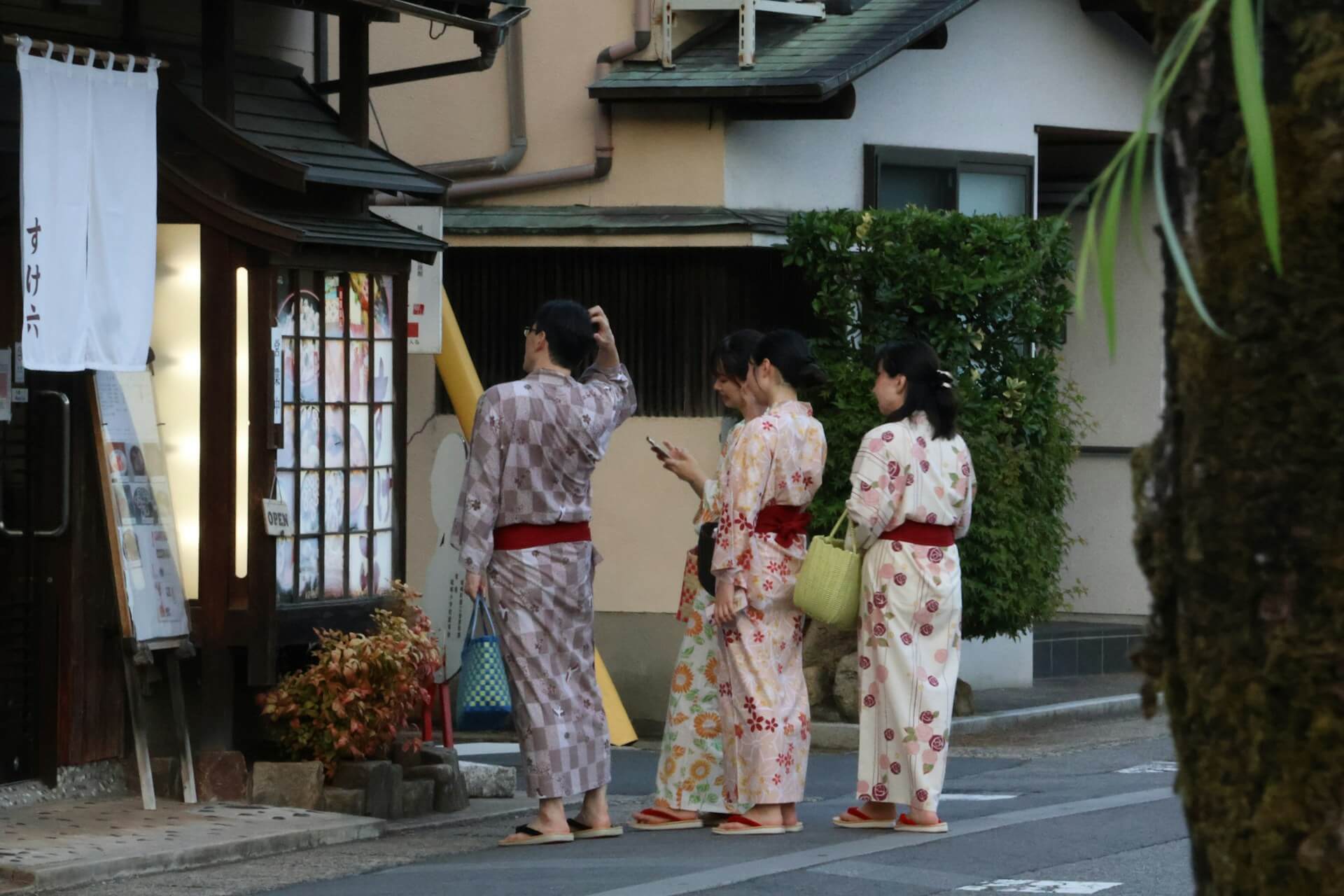
Photo by Yanhao Fang on Unsplash
From soaking in ancient hot springs and sleeping in Buddhist temples to forest bathing, pilgrimage trails and getting buried in hot sand, Japan has some wonderfully weird ways to make you feel better.
I’m a bit of a Japan junky. I seem to need an annual Japan fix, and over the years I’ve discovered that Japan has a remarkable knack for making me feel good. I’m not entirely sure when wellness became part of the deal, but apparently I’m here now. Once upon a time, my Japan trips were mostly about eating whatever I liked, drinking too much plum wine and obsessing over all the kawaii cuteness and cultural overload. These days, I’m considerably more interested in anything that leaves me feeling better than when I arrived.
Happily, Japan has some wonderfully strange ways of making that happen. You can soak yourself in an ancient hot spring, wander through a forest communing with nature, sit cross-legged in a Zen temple or spend several days walking an ancient pilgrimage route. Or perhaps you’d rather sleep in a Buddhist temple, eat like a monk and, if that all sounds a little too sensible, head south and have yourself buried up to the neck in hot volcanic sand because… well, why the heck not?
The Japanese approach to wellness is deeply woven into everyday life, from onsen and simple seasonal food to meditation, nature and rituals that have been around for centuries. And while some of it is deeply peaceful, some of it is downright peculiar. Here’s where to start.
Onsen hot spring bathing
Japan has more than 3,000 hot spring areas, so if your idea of wellness involves getting naked and sitting in very hot water with a bunch of strangers, you are absolutely spoilt for choice.
Onsen are one of the country’s great bathing traditions, with hot spring towns scattered from Hokkaido to Kyushu. Some are attached to ryokans, some are public bathhouses and others are gloriously scenic outdoor pools where you can soak surrounded by mountains, forests or snow.
Whichever you choose, there is some onsen etiquette to learn first. The edited highlights? You strip off, wash, climb into steaming water with a bunch of naked strangers and basically cook yourself until you emerge feeling like someone has hit the reset button. Different springs contain different minerals, and traditionally these mineral-rich waters are believed to have benefits ranging from soothing aching muscles and joints and improving circulation to helping certain skin conditions. Whether you credit the minerals, the heat or simply spending half an hour doing absolutely nothing, it is hard to argue with the restorative appeal.
For the full atmospheric experience, head to Dogo Onsen in Matsuyama on Shikoku. The Dogo Onsen Honkan is one of Japan’s oldest and most famous bathhouses, with a history stretching back more than 3,000 years. It is also famously associated with Spirited Away, although Hayao Miyazaki has never confirmed it was the direct inspiration for the film’s bathhouse. The wooden building is a glorious maze of stairways, corridors and bathing rooms, which makes having a bath feel considerably more adventurous than it probably should.
Arima Onsen near Kobe is another classic. It is one of Japan’s oldest hot spring towns, with more than 1,000 years of history, and is known for two distinctive types of spring water. Kinsen, or ‘gold spring’, is the famous reddish-brown water, while Ginsen, or ‘silver spring’, is clear.
If your idea of relaxation involves first exhausting yourself on a ski slope, Nozawa Onsen in Nagano makes a pretty compelling combination. The village is both a ski resort and historic hot spring town, with public baths dotted around the streets. After a day on the snow, climbing into hot mineral water sounds considerably more appealing than attempting to stretch my hamstrings.
And then there is Ibusuki, where Japan takes the whole getting-hot-and-feeling-better concept in a completely different direction.
Get buried in hot sand at Ibusuki
Ibusuki, at the southern tip of Kagoshima Prefecture on Kyushu, is famous for its sunamushi sand baths, where geothermal heat from the area’s hot springs warms the beach sand. You change into a cotton yukata, lie down and let staff shovel the hot sand over you until you are buried up to your neck. I’m not sure who first looked at a pile of steaming sand and thought, ‘Yes, bury me under that’, but thousands of people a year concur.
The sand reaches around 50 to 55°C, which sounds slightly unhinged until you realise that this is, in fact, the entire point. You lie there sweating for around 10 to 15 minutes, then emerge looking like something that has been slow-roasted, rinse off the sand and finish with a conventional hot spring bath. The experience is traditionally believed to promote circulation and leave you feeling refreshed.
It is apparently very good for you. I am a little stuck on the part where you voluntarily lie down while someone buries you. Still, if the Japanese have taught us anything, it is that there are apparently many roads to wellness. Some of them just happen to involve a shovel.
Go forest bathing
Forest bathing, or shinrin-yoku, sounds like something that should involve a tub. It doesn’t. There are, however, a lot of leaves.
In reality, it means slowing down in a forest and paying attention to what is around you, using all your senses rather than simply walking through it on the way to somewhere else. And it can be surprisingly lovely.
The wind moves through the trees, fallen leaves rustle underfoot and the air smells of damp earth, decaying wood and eucalyptus. Sunlight filters through the canopy. Somewhere in the distance a bird is making itself known. You breathe in, breathe out and, for a little while, the mental noise seems to turn down.
That is really the point of shinrin-yoku. It isn’t a bushwalk, and there is no particular destination. You might walk slowly, sit on a rock, listen to the birds, notice the texture of bark or simply stand among the trees doing very little. The idea is to immerse yourself in the forest rather than conquer it.
The modern practice emerged in Japan in the 1980s, inspired in part by the country’s longstanding reverence for nature. The Japanese Ministry of Agriculture, Forestry and Fisheries promoted shinrin-yoku as a way of encouraging people to spend time in forests, and it has since become a global wellness practice.
Japan is a particularly good place to try it, with forests covering around two-thirds of the country and dedicated forest therapy experiences in places such as Nagano and the Kii Peninsula. In Nagano’s Shinanomachi, forest healing guides lead visitors through the landscape, while the Kumano Kodo pilgrimage routes in Wakayama combine forest, spirituality and walking in one rather impressive package. Research has linked forest bathing with changes in things such as stress, heart rate and blood pressure, and in practice I can believe it, there is something restorative about being in nature.
The nice thing about shinrin-yoku is that there is no achievement component. Nobody is waiting at the end with a medal or asking for your pace. You just wander around looking at trees. Easy.
Try Zen meditation
Zen is not simply a Japanese word for feeling relaxed, despite the number of candles, cushions and spa brochures that might suggest otherwise. Zen Buddhism places considerable emphasis on meditation and awareness, with zazen, or seated meditation, one of the practices visitors can experience at temples around Japan.
One of the easiest places to try it is Shunkoin Temple in Kyoto’s Myoshinji complex, where English-language Zen experiences include meditation, Buddhist philosophy and tea. There are also private Zen experiences and scheduled one-day and three-day retreats.
And this is where Japan gets particularly good at making wellness feel like something other than a wellness product. You’re not necessarily going to a retreat centre decorated in pale timber and beige linen. You are sitting inside a working Buddhist temple, learning about a tradition that has been part of Japanese culture for centuries.
Shunkoin also offers overnight retreats combining meditation with things such as calligraphy, tea ceremony and discussions with the resident priest.
I’m pretty sure I have the Zen temperament required for prolonged periods of sitting still. It’s the physical ability I’m less confident about. As a bona fide fidgeter with creaky knees and hips ageing at a pace that will soon require carbon dating, sitting cross-legged for any length of time could be challenging. But I’d give it one hell of a try.
Sleep in a Buddhist temple
If meditation sounds appealing but you would also like somewhere to actually sleep afterwards, shukubo offers the chance to stay overnight at a Buddhist temple.
Temple stays originally developed to accommodate pilgrims, but today travellers can stay in temple lodgings, join meditation or other Buddhist practices and eat shojin ryori, the traditional vegetarian cuisine associated with Buddhist monks. It is one of those experiences that changes the rhythm of a trip. Instead of rushing out to see another temple before breakfast, you are actually staying in one. Depending on where you go, the experience can include meditation, chanting, temple rituals and simple meals.
There are temple stays across Japan, including on the sacred Dewa Sanzan mountains in Yamagata and along the Shikoku 88 Temple Pilgrimage.
For anyone who finds the idea of a conventional wellness retreat a little too polished, this is probably the other end of the spectrum. You get a temple, a futon and somebody else’s centuries-old spiritual practice to contemplate.
As for me, I have always had a soft spot for monks. I like the robes, the chanting and the general air of nonchalance. So this is very much up my accommodation alley.
Walk the Kumano Kodo
For some people, who are not me, wellness apparently requires walking for several days through ancient forests. The Kumano Kodo should keep those people happy. Me, I’ll be chasing monks with a green juice in hand.
I jest, the UNESCO-listed pilgrimage routes do genuinely sound incredible. They run through the Kii Peninsula, where pilgrims have been walking between sacred sites for centuries. Today you can tackle anything from short walks of a few hours to multi-day treks, passing through forest, mountain villages, shrines and temples along the way.
The Kumano Kodo has a strong spiritual connection, but you don’t have to be religious to appreciate the experience. There is something inherently restorative about spending several days walking through a landscape where the pace of life is dictated by your feet rather than your phone.
And unlike a wellness retreat, nobody can sell you a treatment while you’re doing it.
Eat like a monk
Wellness in Japan isn’t all about submerging in hot water or sitting still. Food is very much part of the picture too. Yay!
Shojin ryori is the traditional vegetarian cuisine associated with Japanese Buddhist monks. It is built around seasonal vegetables, tofu and other plant-based ingredients, with a strong emphasis on simplicity, balance and avoiding waste. It is generally found in Buddhist temples and temple lodgings rather than ordinary restaurants.
The food is beautifully presented but isn’t really about showing off. The idea is that eating is part of the contemplative experience, with care taken over ingredients, preparation and presentation.
There is also something wonderfully practical about a cuisine in which even the bits of vegetables you might normally throw away can end up in the stock. I’m certianly impressed by a cuisine that refuses to let a perfectly good vegetable end its days in the bin.
Try misogi, a Shinto purification ritual
If meditation involves sitting quietly with your thoughts, misogi takes a rather more energetic approach to clearing the decks.
Misogi is a traditional Shinto purification practice involving water. The practice ccacanvolve standing beneath a waterfall or entering cold water as part of a ritual purification, with the experience rooted in Shinto rather than modern wellness culture.
Which is interesting, given that the rest of the wellness world has spent the past few years getting excited about getting very, very cold. Wim Hof and the whole cold-plunge movement have turned icy water into a wellness trend. Japan, meanwhile, has been getting naked under waterfalls for more than 1,000 years, with references to water purification rituals appearing in Japan’s early texts, including the Kojiki (712 CE) and Nihon Shoki (72 CE). I feel there may be a lesson here somewhere.
There are places where visitors can experience misogi under guidance, including Shirayama-Hime Shrine near Kanazawa, where participants enter cold water as part of a traditional purification ceremony. In Uchiko on Shikoku, you can even stand beneath a 17-metre waterfall as part of a guided misogi experience. It’s not exactly a spa day, but it will certainly clear the mind.
Stay at Amanemu for a little luxury
And then there is Amanemu, which takes everything Japan does naturally and turns it into something spectacularly luxurious.
Set in Ise-Shima National Park on Ago Bay, Amanemu is an onsen resort built around Japan’s long bathing tradition. Its 2,000-square-metre spa has thermal spring facilities, private onsen pavilions, treatment rooms, yoga and fitness spaces and treatments incorporating Japanese practices such as Kampo herbal therapies, acupuncture and shiatsu.
There are also more structured wellness immersions covering mindfulness and stress management, recovery and recuperation, detox and cleansing and other wellbeing goals. Current programmes can combine zazen meditation, tea ceremony, onsen therapy, massage, acupuncture, nutrition and movement.
It is very cool. It is also very much out of my budget, unless anyone feels like shouting me a few nights. I’m always open to offers. Still, for those with the budget, this is Japanese wellness at the luxury end of the scale, with the onsen, landscape and traditions of the region woven into the whole experience rather than bolted onto a luxury hotel.
What are the best wellness experiences in Japan?
The best wellness experiences in Japan depend rather heavily on what you think wellness actually means. For a classic Japanese experience, start with an onsen. If nature is your thing, try forest bathing or walk part of the Kumano Kodo. For something more spiritual, look at Zen meditation or a Buddhist temple stay. If you want something genuinely strange, go to Ibusuki and get buried in hot sand.
And if you have the budget for the full luxury experience, Amanemu combines onsen, Japanese traditions, nature and seriously good service in one very beautiful package.
The thing I like about wellness in Japan is that it doesn’t have to look like wellness. It can be a bath, a forest, a pilgrimage, a bowl of vegetables, a temple or, apparently, getting buried up to your neck in hot sand and calling it self-care.
Some of it sounds lovely. Some of it sounds completely bonkers. Sign me up for all of it because bonkers is my bag, baby.
 An award-winning travel writer and photographer, Aleney de Winter was fresh from school when she first set off to explore the far reaches of Australia with a two-man tent and a beaten-up Kingswood for company. Three decades, and two kids later, and she's still on the go, with her itchy-footed offspring in tow.